July 6, 2026
Why Every Nigerian Child Should Learn to Code
When we talk about literacy in Nigeria, we usually mean reading and writing. But there is a second kind of literacy that is becoming just as essential — and most of our children are being sent into the future without it.
Coding, at its most basic, is the ability to give a computer a set of instructions. But in practice, learning to code teaches something far more valuable: how to think logically, break a problem into smaller pieces, test ideas, and learn from mistakes. These are skills that apply everywhere — not just in front of a screen.
The jobs are already here
Nigeria’s technology sector is growing faster than the educational system is producing people to fill it. Across Lagos, Ibadan, Abuja, and Port Harcourt, companies are hiring — and struggling to find enough qualified developers, data analysts, and digital professionals. The gap between what the market needs and what our schools are producing is already significant. By the time today’s primary school pupils enter the workforce, that gap will be wider still.
But this is not just a jobs argument. A child who learns to code learns to build things — apps, websites, games, tools. They learn that when something breaks, you debug it. When something does not work the way you expected, you adjust the approach and try again. These habits of mind are useful whether the child grows up to be a software engineer, a doctor, a teacher, or a business owner.
Starting young is an advantage
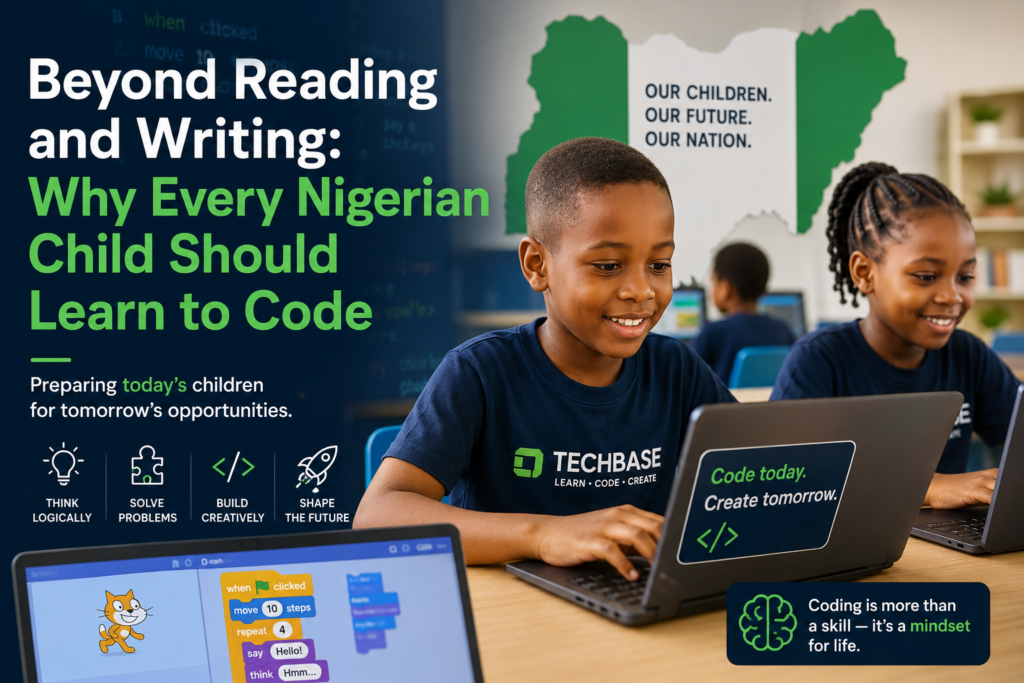
At Techbase, we start children as young as five with Scratch — a visual, block-based programming environment developed by MIT. There is no typing required. You drag and connect colourful blocks to make characters move, play music, and tell stories. It looks like a game. It teaches like a masterclass.
Children who start with Scratch progress naturally to text-based languages. We have watched six-year-olds who began with drag-and-drop coding move to writing real HTML and CSS by age eight or nine. The progression is gradual, structured, and — critically — enjoyable.
What schools can do right now
Every school in Nigeria can take a first step toward coding education this term. You do not need a dedicated computer lab. You do not need to hire a specialist full-time. What you need is a structured curriculum, a capable instructor, and a regular weekly slot. Techbase can provide all three.
The question is not whether Nigerian children should learn to code. They should, and increasingly they will — in one context or another. The question is whether your school or your family wants to be early, or to catch up later.